video · pricing · comparison
What AI video costs: 21 models priced per second
From $0.02 to $3 per second: what a short clip costs on 21 video models, why a listed price can be the price of the longest clip, and one same-start test.
· Updated · 6 min read
AI video is priced per second, per resolution and sometimes per sound track, and every provider writes its prices differently. This post puts 21 of the video models you can run through Photoproduct on one scale: what a short clip costs, and what that is per second.
Then it does the part a price list can't: the same 5-second clip, from the same start image and the same prompt, on five models from 5 to 20 credits.
How the prices were measured
Every price below is what Photoproduct charges for a 5-second clip at the model's default resolution, in whole credits as billed. Models that only come in fixed lengths are shown at their default length. Per second is that charge divided by the clip's length, at $0.10 a credit.
These are the prices of 7 November 2026. They move, so the live catalog is always the source: list_models for an agent, or the public catalog at /api/public/models.
The table
| Model | Resolution | Clip price | Per second | Listed price |
|---|---|---|---|---|
| Vidu Q3 Turbo | 720p | 1 credit, 5 s | $0.02 | |
| Gemini Omni Flash 1.1 | 720p | 3 credits, 5 s | $0.06 | 5 (8 s default) |
| MiniMax H3 Max Turbo | 768p | 4 credits, 5 s | $0.08 | |
| Pixverse v6 | 720p | 5 credits, 5 s | $0.10 | |
| Kling 2.5 Turbo Standard | fixed | 5 credits, 5 s | $0.10 | |
| Veo 3.1 Lite | 720p | 8 credits, 8 s | $0.10 | |
| Kling 2.6 Pro | fixed | 8 credits, 5 s | $0.16 | |
| MiniMax H3 Max | 768p | 8 credits, 5 s | $0.16 | |
| Wan 2.7 | 1080p | 10 credits, 5 s | $0.20 | |
| MiniMax H3 | 2K | 13 credits, 5 s | $0.26 | |
| Happy Horse 1.1 | 1080p | 15 credits, 5 s | $0.30 | |
| Kling O3 Pro | fixed | 15 credits, 5 s | $0.30 | |
| Veo 3.1 Fast | 720p | 24 credits, 8 s | $0.30 | |
| FLUX 3 | 720p | 18 credits, 5 s | $0.36 | 69 (longest clip) |
| Wan 3.0 | 1080p | 20 credits, 5 s | $0.40 | |
| Seedance 2.0 Fast | 720p | 25 credits, 5 s | $0.50 | 73 (longest clip) |
| Seedance 2.0 | 720p | 31 credits, 5 s | $0.62 | 91 (longest clip) |
| Veo 3.1 | 720p | 64 credits, 8 s | $0.80 | |
| Kling O3 4K | 4K | 42 credits, 5 s | $0.84 | |
| Seedance 2.5 | 720p | 48 credits, 5 s | $0.96 | 284 (longest clip) |
| Marey | fixed | 150 credits, 5 s | $3.00 |
The names to use with run and list_models, in the same order:
vidu/q3/image-to-video/turbo
google/gemini-omni-flash/v1.1/image-to-video
minimax/h3-max-turbo/image-to-video
pixverse/v6/image-to-video
kling-video/v2.5-turbo/standard/image-to-video
veo3.1/lite/image-to-video
kling-video/v2.6/pro/image-to-video
minimax/h3-max/image-to-video
wan/v2.7/image-to-video
minimax/h3/image-to-video
alibaba/happy-horse/v1.1/image-to-video
kling-video/o3/pro/image-to-video
veo3.1/fast/image-to-video
blackforestlabs/flux-3/image-to-video
alibaba/wan-3.0/image-to-video
bytedance/seedance-2.0/fast/image-to-video
bytedance/seedance-2.0/image-to-video
veo3.1/image-to-video
kling-video/o3/4k/image-to-video
bytedance/seedance-2.5/image-to-video
moonvalley/marey/i2v
All are image-to-video, the usual starting point for product and character clips. In almost every family the text-to-video version costs the same. "Fixed" means the model offers no resolution setting.
What the table says
The spread is 150 to 1. A second of video costs from $0.02 to $3.00. Most models a creator would reach for sit between $0.08 and $0.30 a second, so a 5-second clip costs 4 to 15 credits.
A listed price can be the price of the longest clip. FLUX 3 and the Seedance models let you leave the length to the model. When you do, the catalog can't know how long the clip will be, so it quotes the longest one and says so: price_basis is duration_ceiling. Seedance 2.0 is listed at 91 credits; a 5-second clip costs 31. Set duration yourself and the quote follows it.
Resolution and sound are most of the price. Inside one family the steps are plain: MiniMax H3 Max Turbo at 768p costs $0.08 a second, H3 Max at 768p $0.16, H3 at 2K $0.26. Wan 3.0 shows it inside a single model: $0.10 a second at 480p, $0.20 at 720p and $0.40 at its default 1080p, sound included at every step.
Veo comes in fixed lengths. It offers 4, 6 or 8 seconds, so it is shown at 8. Per second, Veo 3.1 Lite costs the same as Pixverse v6 and Kling 2.5 Turbo Standard, and the full Veo 3.1 eight times as much.
Same start, five models
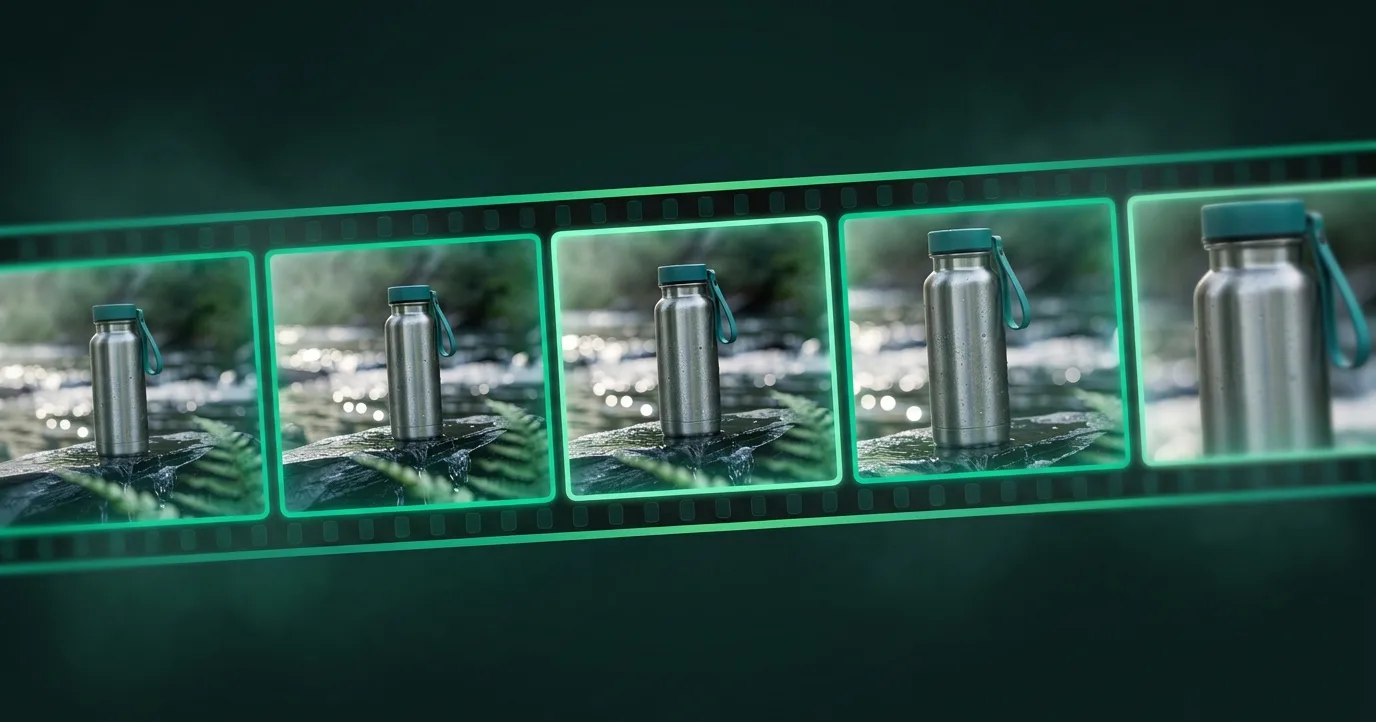
A price list says nothing about the result, so we made the same clip five times. Start image: the steel bottle from the setup guide, passed by its job_ref. Duration: 5 seconds. Resolution: each model's default, because that is what its price covers. Prompt, for all five:
The camera slowly pushes in on the steel bottle while the mountain stream flows and sparkles behind it. Water droplets slide down the brushed steel, the fern in the foreground sways gently in a light breeze. Natural morning light, smooth steady camera, no cuts. No text, no logos.
| Model | Credits | Delivered | The camera move |
|---|---|---|---|
| Pixverse v6 | 5 | 1108 × 832, 24 fps, no sound | pushes in as asked |
| Kling 2.5 Turbo Standard | 5 | 1108 × 828, 24 fps, no sound | barely moves |
| Wan 3.0 | 20 | 1662 × 1246, 30 fps, with sound | pushes in too far, crops the lid |
| MiniMax H3 | 13 | 2224 × 1664, 24 fps, with sound | a steady push-in that keeps the lid in frame |
| Happy Horse 1.1 | 15 | 1662 × 1248, 24 fps, with sound | pushes in until the lid is gone |

All five kept the bottle intact: the same shape, the same teal lid and strap. They differ in how literally they took slowly pushes in. MiniMax H3 did exactly that, at 2K and with sound. The 5-credit Pixverse clip came second, ahead of Happy Horse and Wan at three and four times its price, which says more about the gap between price and fit than any table. The 15-credit model overshot.
At today's prices the comparison costs 58 credits, $5.80.
How to shop
Price buys resolution and sound. It does not buy obedience, so the cheapest model that does the job is often a cheap one plus a retake. A run that fails costs nothing, but a run that completes and misses the brief is paid like any other, and a 5-credit retake is still cheaper than a 13-credit first try.
An agent can shop the same way. Give it a budget and it filters the catalog for you:
{ "name": "list_models", "arguments": { "category": "image-to-video", "max_credits": 8, "compact": true } }max_credits filters on the listed price, so models listed at their longest clip drop out even if a 5-second clip would fit. Add "include_variable": true to keep them in the list, then set duration when you run.
The setup guide connects your agent; the scheduled agent shows one shopping inside an 8-credit limit on its own.